The Real Most Interesting Man In The World
by Mariah Moyle
23 May, 2018
When you arrive to Cat Island, something in you switches. It doesn’t matter if you came from New York City, or Nassau, or another Out Island of The Bahamas. There is something about Cat Island that moves in a different way. Maybe it’s the remnants and ruins of stone buildings and plantations that dot the island, dating back to the 1700s loyalist period. You can almost sense the energy of the once-bustling population of around 10,000 people on the island, with a booming economy in sisal. But now, it’s quiet. Maybe it’s the obeah, or black magic, where stories of ill-fated curse-receivers convince even those who might not believe in such hoo-doo.
Whatever it is, one thing is inevitable: you will most likely fall in love with this island. It provides visitors with wow after spectacular wow. One of my many wows was my time spent at Fernandez Bay and meeting Tony Armbrister and his family. I’m sure you’ve all heard of the Dos Equis guy? Touted as being the “most interesting man in the world?” Well, I am here to say the Dos Equis guy has nothing on Mr. Tony Armbrister.
Being a small island nation, it doesn’t matter which island you are on; everyone is connected by one degree of separation, instead of the standard six. Prior to my visit, I was introduced to Tony through various avenues, and upon my trip to Cat Island, I had the opportunity to stay at Fernandez Bay Village, which he established in the 1970s, and today he is running it along with his daughter Tameron, her husband Jason, and now their 7-month-old baby. His wife Pam’s parents live in the neighborhood, and between the Armbrister family and the warm and welcoming staff, you will surely feel at home.
Tony can trace his ancestry back to the first Armbristers to arrive in The Bahamas in the late 1700s as British Loyalists exiled from America by the Revolution. His great-grandfather had land holdings on Cat Island (known then as San Salvador), and his mother convinced his father, who had been born in Nassau and moved to California, to return to The Bahamas.
He said that someone once told him he sounded like a book, which is exactly true. He is a walking storybook, and his tales will captivate you. I had the privilege of hiking with him to The Hermitage. I stayed quiet as he wove through the history of his great-grandfather, a Nassau merchant, and his grandfather, who had his father at the age of seventy-six when he married a thirty-seven-year-old. His father had two sons, Tony and his brother Cyril Jr.
As we hiked the steep trail to the highest point in The Bahamas, he pointed out the stations of the cross and the replica of the final tomb where Jesus resurrected. The stairs were steep and narrow, a nearly vertical incline. It was a rare instance when my fear of heights emerged in my otherwise sea-level environment. He pointed to a small cave where Father Jerome was buried, with a cross on the stone above marking his whereabouts.
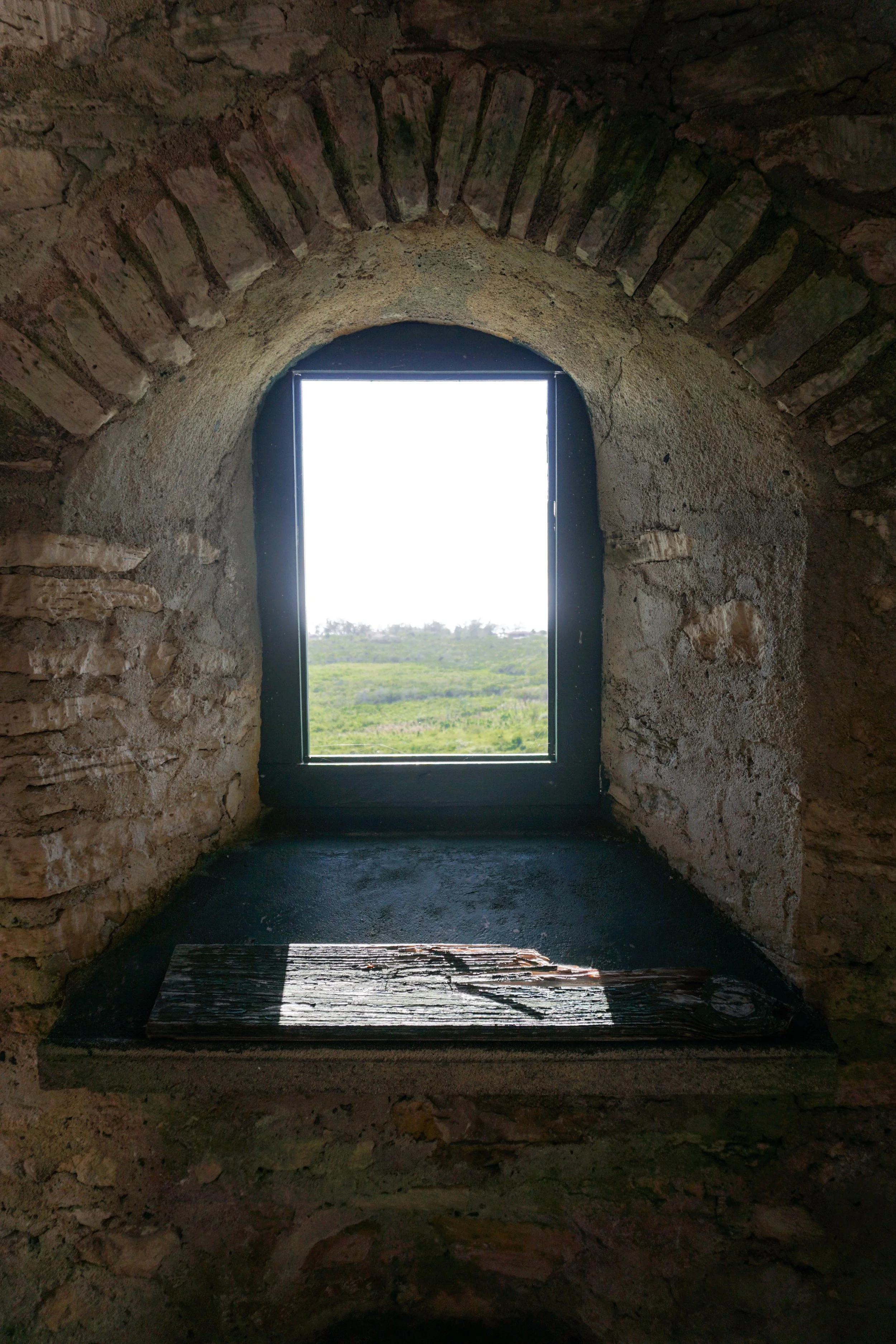
The writing desk at The Hermitage
Inside the stone hermitage, there was a “bed” on the concrete floor, not exactly luxe accommodations. There was a writing desk overlooking the Exuma Sound, a small kitchen on the lee, a shower with a drain, and a rainwater collecting system with a pump handle. Down past the main site was what appeared to be a bread oven. We worked our way down the other side of the hill, and Tony showed me something else that I otherwise wouldn’t have found on my own. We bushwhacked down an overgrown path to a small cave where Father Jerome lived while he was constructing his abode. It was even more rustic than the actual Hermitage, and I saluted that man for living in conditions that would now be suited for a wilderness reality TV show. Tony said his father was fortunate enough to meet him in person while he was still alive.
We returned to the resort, and I continued to ask questions. He told me about obeah, the black magic of the island. He said that one time, when he was a young lad of about 18 years old, he was invited onto someone’s boat with a few other locals. The topic of black magic came up, and he was adamant he didn’t believe in it, until he was invited back to receive a hex the next evening, where he would surely die in two days. He politely declined the invitation to dabble in this dark side, and he has never questioned black magic since.
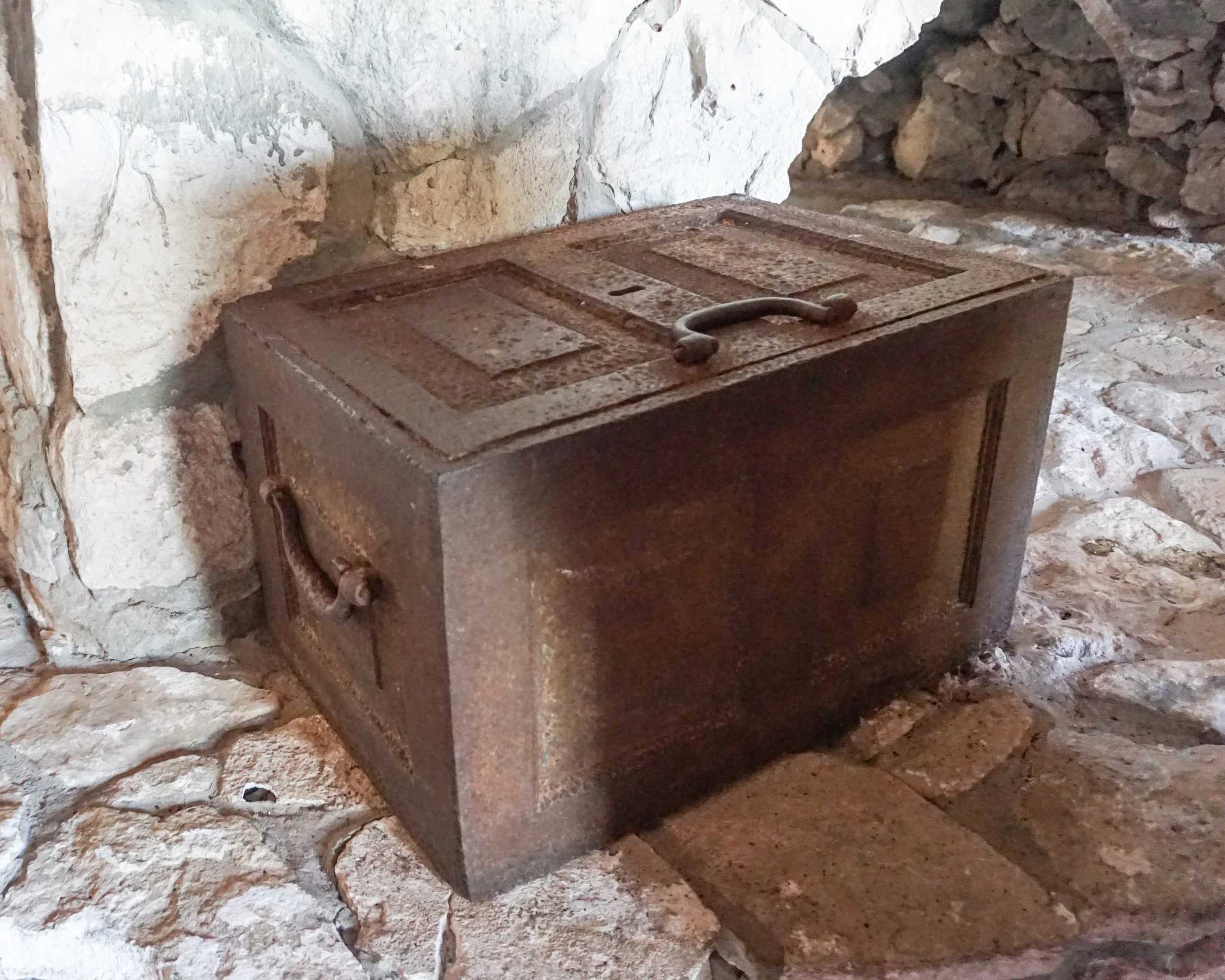
Treasure chest from the 1700s in the lobby at Fernandez Bay Village
He also told me about the mysterious treasure chest from the 1700s that was dug up on the Armbrister’s Port Howe Estate, a sisal plantation owned by Sir William Armbrister, Tony’s grandfather. The daughter of the overseer of the estate was sure there was gold on the property because her father had gone searching for it when Sir William passed away. It was customary to pay wages in gold coins, so there must have been some hidden around the property. Port Howe was a popular hangout for pirates back in the day, so the chest may have been stolen or salvaged from a passing or sinking ship. It was found buried in the bush with the help of metal detectors. Tony has been adamant about not breaking in and damaging the chest, so to this day, they don’t know what the contents are.
Tony also told me about the logo when I was asking how Fernandez Bay Village got its name. The logo is of an old sailing ship, something that would have inspired an explorer. In my mind, it conjured up the great explorer Fernandez. He went on to tell me two stories. Fernandez is not a common name in The Bahamas, but Fernander is. His guess was that in the old scripts, the calligraphic “r” was misread as a “z” at one point, forever calling this body of water Fernandez Bay.
The story of the logo came elsewhere. While he was establishing his new venture in the 1970s, he was set to fly (yes, he was also a pilot in his day, add that to the list of being the most interesting man in the world), a group from Florida to Bimini. One of the women was doing her final project for her Marketing degree in which she had to pick a business and propose a logo. She asked Tony if he might be interested in having her design the logo for his new resort, and he agreed. She said he was at no liberty to use the logo, but it was part of her project. Several months later, she presented Tony with the logo she designed: the sailing ship with a pineapple, both the international symbol of hospitality and an agricultural heritage of the island, with the words Cat Island written in the waves below the hull. The logo stuck, and is the same to this day.
I was shown my room, Shane Shack, and it was anything but a shack. It was an adorable stone cottage with a covered verandah, literally steps from the peaceful shorebreak. Powder-soft sand stretches into the bay, an utterly inviting place for an afternoon swim.
Later, during happy hour at the open-air stone clubhouse, I asked Tony about the Columbus controversy. It is known throughout the Bahamas that Columbus’s first stop in the New World was not Plymouth Rock, or anywhere in mainland America, but on an island in The Bahamas. I’ve read several articles over the years that delve into this, debating that Columbus may have originally landed on Cat Island. Tony explained that Columbus’s journals were lost, and the rewritten ones described Columbus landing on San Salvador. As of the 1930s, Cat Island was simultaneously referred to as Catt’s Island, after pirate Arthur Catt, and also as San Salvador, by the Spanish. Today’s San Salvador was once known as Watling’s Island. The term San Salvador bounced interchangeably from Catt’s Island and Watling’s Island until the British government assigned the official name of San Salvador to the little island just to the east of Cat Island, immediately giving that island claim to being the initial landing stop of Columbus. To this day, it remains a mystery, but you’ll find Columbus Point on Cat Island, a Columbus monument and cove on Long Island, and a Columbus monument on San Salvador.
Tony told me that he thought that his mother should have written a book about her and her husband’s life and times in Cat Island, but she never did. I believe it’s now up to Tony to write this book. The world deserves to hear the stories from the real most interesting man in the world.
Considering relocating, investing, or building in the Bahamas?
Our team at PanCaribbean Consulting Group helps international clients with
property acquisition, development, and relocation strategy.
Reach out to us for more information, or visit the PanCaribbean Consulting Group website