Twenty Generations of Cat Islanders
by Mariah Moyle
29 November, 2018
I sit in the domestic terminal in Nassau and await my flight to Cat Island. It’s a lanky island east and center within the archipelago of the Bahamas. It’s not a well-known destination, if anything, perhaps somewhat of an underdog of the feline kind. A certain number of its locals are hopeful that an economic boom is on the way, but others prefer it just the way it is—subdued, remote, and enigmatic.
My flight is announced, and we are informed that the plane is flying into Arthur’s Town, instead of my final destination of New Bight, where I had pre-booked a rental car. The kindly agent assures me that arrangements have been made for passengers to be shuttled on to their journey’s end.
The pint-sized turboprop touches down in Arthur’s Town. I enter the one-room terminal, a no-frills concrete building where we awkwardly crowd in among departing passengers and wait for our bags to come out on a hand-pushed trolley.
As I wait, an ample-bodied woman with dark skin and a shiny complexion approaches me. “You goin’ da Bight, hey?” I nod. The town is interchangeably known as New Bight, or simply The Bight. She introduces herself as Cleopatra, the taxi driver who was hired by the airline to take a few passengers to their ticketed destination. I can’t quite be sure why she singled me out in particular, but perhaps I carried the demeanor of someone who was merely passing through.
My bag arrives, and I follow her as she marches outside towards a van parked sideways alongside the runway. She motions for me to load my luggage into the back, and I slide in alongside three other local women. The conversation that ensues over the 30-mile trip covers a lively array of the resident social gamut—innocent gossip, indulgent scandal, and poignant suggestions directed at various absent acquaintances on child-rearing techniques and love lessons. I make myself invisible, as I’m unable to contribute to the conversation among this allied connection of lifelong islanders.
We amble south along Queen’s Highway, the name of nearly every main road on every island within the archipelago, stemming from the days under the British crown in the not-so-distant past. We are seemingly navigating at the pace of a horse-drawn wagon as we take our time to avoid potholes. I stare out the window. Rolling hills draped in scrappy native bush line the horizon, edged at street level by periodic ramshackle concrete homes. On the other side, the limestone iron-shoreline dissects the vibrant sea from the sun-bleached highway.
The island is home to a population of roughly 1,500 people and sees considerably fewer visitors than the other more popular Bahamas destinations that take claim to mega-resorts, famous swimming pigs, and blue holes. Those that do arrive in Cat Island are visiting with intention. No one just seems to stumble upon the place. New residents rarely come, with a limited economy to support them, and existing residents rarely go, stalwart of their heritage-land. Because of this, Cat Island, it seems, has been able to live in somewhat of a self-contained population bubble, spanning not just decades, but generations.
The island is littered with stone ruins from the plantation era, and cotton grows unattended and untamed on the roadsides. The economy is sparse, but the people here smile with a sense of genuine contentment, pleased to be removed from bombardments of commercialism and rigid social rules. Not everything works here, but the attraction is the sense of the old Wild West, which is becoming seemingly obsolete around the rest of the world.
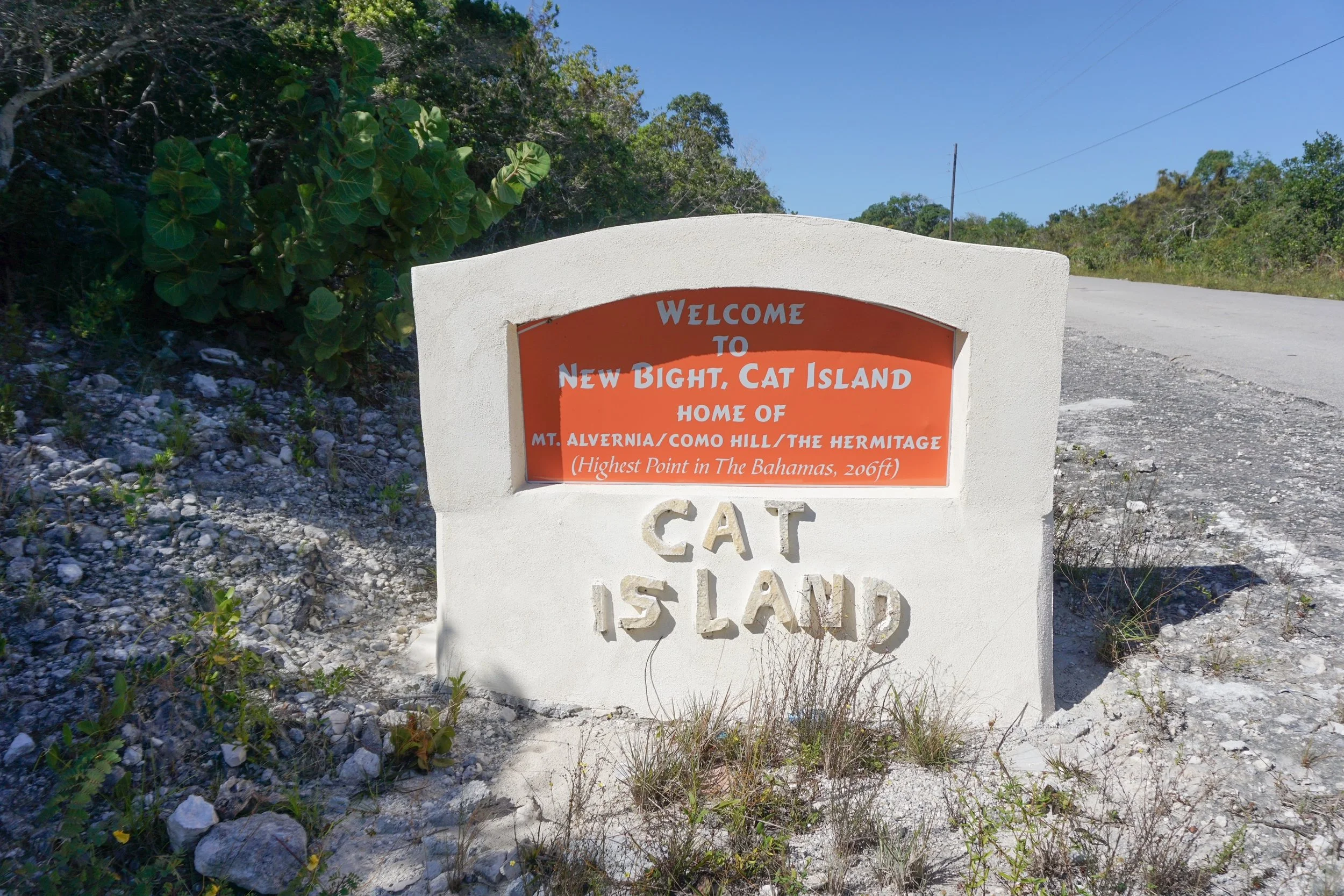
I am dropped at the New Bight Food Store. I enter to inquire about my rental car, and I'm signaled to stand in line. I wait patiently for a woman to check out her brimming grocery cart before approaching the counter to fill out the appropriate forms to rent my car.
After I get my car, I take a short ride through town to catch my bearings, and eventually find myself driving down a sandy road to Fernandez Bay Village, a family-owned and operated boutique Out Island resort that’s been in operation since the 1960s. I’m due to meet Tony Armbrister, and he greets me in the driveway. Although we didn’t have a pre-arranged meeting time, he saunters up as if he had been waiting for me to arrive.
Tall and lean with a two-day shadow, he wears an outback hat and a fishing shirt. When he speaks, he offers only the slightest twang of someone who has spent a good part of his life in the islands. He has a steady and reserved demeanor, and I instantly relate him to the Dos Equis persona of the “most interesting man in the world.”
We waste no time and hop in his oversized pickup. He shuffles papers and jackets aside, allowing me space in the passenger seat. Within minutes, we are pulling up to the base of Mt. Alvernia. As we step out onto the side of the road, we are staring up at the highest point in the Bahamas, a dizzying 206 feet in altitude. Perched at the top is The Hermitage, a stone dwelling built by an English Catholic priest in the 1920s as a spiritual retreat.
Tony said that someone once told him he sounded like a talking-book, and this quickly becomes evident. As we walk up the stony trail, I remain quiet as he weaves through the history of his great-grandfather, a Nassau merchant and the first of the Armbristers in his lineage to arrive in the Bahamas in the late 1700s as a British Loyalist exiled from America by the Revolution. His great-grandfather had land holdings in Cat Island as part of the booming plantation industry. Fast forward a few generations to Tony, who, in the 1960s as a young and industrious entrepreneur, followed his roots to his family land holdings in Cat Island and opened the resort. Now, between himself and his wife’s family, four generations live on Cat Island and work to create a welcoming refuge for visitors looking to escape the bustle of their everyday lives.
We continue onward, straight upwards, it seems. Tony points out the stations of the cross and the replica of the final tomb where Jesus was resurrected. The stairs are steep and narrow, and despite my usual sure-footedness, I start to feel woozy in the otherwise sea-level environment I have become accustomed to.
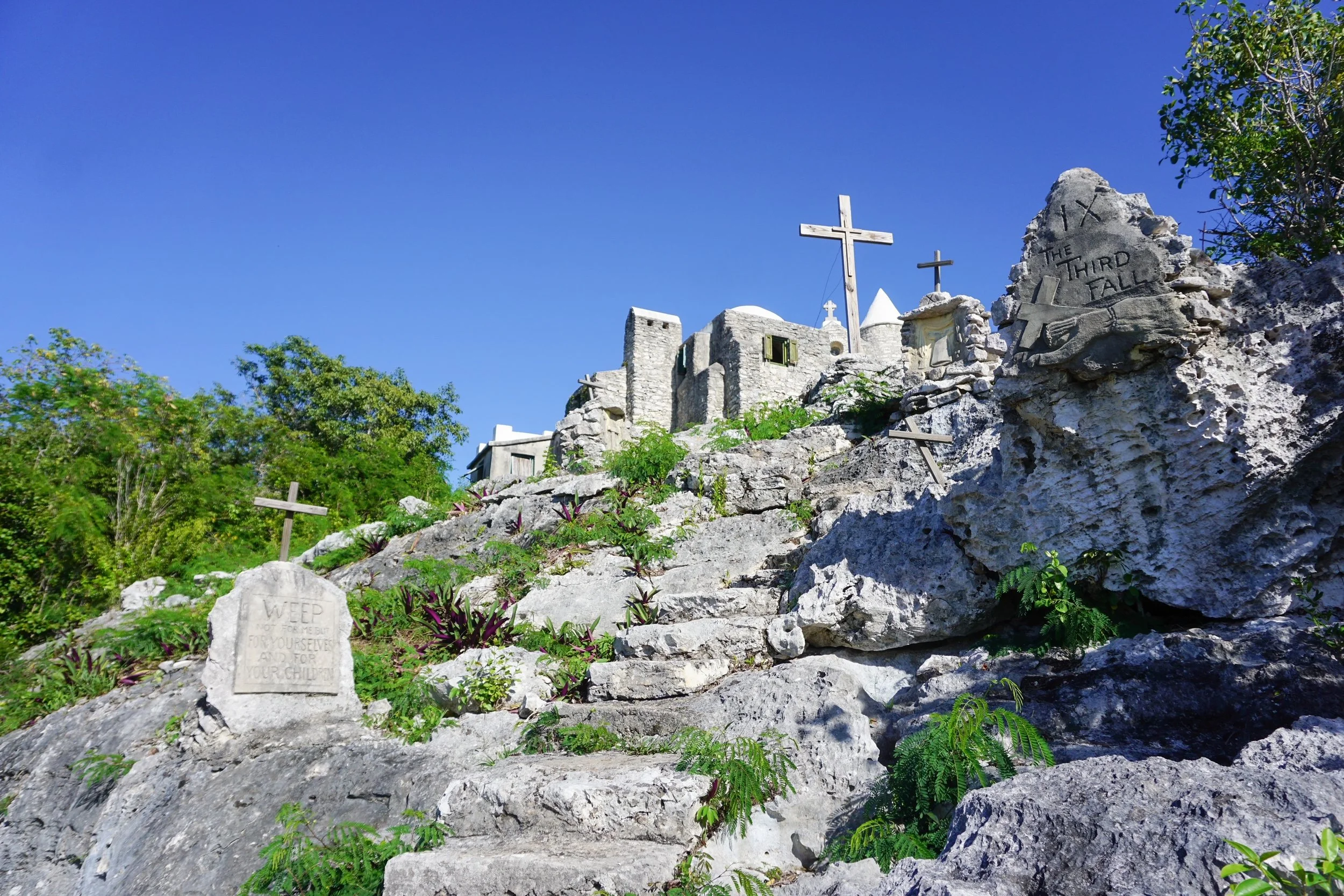
As we arrive at the top, he points to a small cave where the hermit priest was buried. The modest stone structure has windows devoid of glass, a bed on the concrete floor, a writing desk overlooking the Exuma Sound, and a small kitchen located on the lee side.
The view is stunning, and we stand for a moment in silence, taking it all in. I gaze out across the rolling hills, the Atlantic Ocean just visible to the east, and Hawk’s Nest, the Italian-style boot that juts out into the Exuma Sound to the west. The sundial shows us that the afternoon is waning, so we relish the final moments of the view from The Bahamas’ grandest mountain and turn to make our way down.
Later that afternoon I find myself driving solo through Port Howe on the very southern end of the island. A cheerful orange building catches my attention, so I pull off the side of the road. I open the creaky screen door, and it slams behind me. The store is empty, so I busy myself by admiring the hot sauces, pickled vegetables, pepper jellies, and other homemade curations. A woman emerges from the back, smiles at me warmly, and introduces herself as Daisy Mae.
She tells me her family has been on Cat Island since the early 1800s. Twenty generations, she tells me. Can you believe that, twenty?” I tell her that it truly is hard to believe as I attempt to equate the inequatable math in my head, presuming she has veered vertically and is counting the odd cousin or two.
There are fourteen plantation ruins in South Cat Island, and she can weave a rich history of them all. She rattles off great-great-family members who were involved with each of them in some way or another.
That evening, from my cottage at Fernandez Bay Village, I watch the sun sink over the bay and melt into the ocean. In the moment that the sun slipped out of sight, I saw for the first time ever, the green flash—vivid and glowing, a stark contrast to the saturating orange I had just been witnessing. In an instant, it was gone.
Later, I make my way up to the open-air stone clubhouse with its thatched roof and hand-cut stone floor. I pour myself a glass of wine from the honor bar and watch sailboat anchor lights twinkle against the backlight of stars, casting their beams outward in an otherwise un-light-polluted night sky. Tony’s mother-in-law chases around their toddling grandson. She catches him and hoists him up on her hip, and then she makes her way around the clubhouse, mingling with the evening’s guests.
As I linger in these final moments of the day, I am left to wonder how much longer these legacies will continue on. Twenty more generations of Cat Islanders? Perhaps, just as my green flash, their stories are only fleeting moments in time.
Considering relocating, investing, or building in the Bahamas?
Our team at PanCaribbean Consulting Group helps international clients with
property acquisition, development, and relocation strategy.
Reach out to us for more information, or visit the PanCaribbean Consulting Group website